
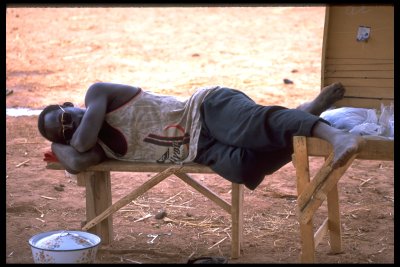
I’ve had lying on my mind lately. I mean flat out, horizontal, no holds barred, delicious, snooze-inducing lying down. It’s not talked about much in the debate whether we should sit, stand, or treadmill our way to better lives. But I say, hey, lying is where it’s at when you are tired, when you need a break, when you need a rest.
My son Nathan knows this quite well. When he Skypes with us, he is usually in his bed, covers pulled up high, computer set on the covers. He works lying, surfs lying, thinks about algorithms lying down.
Get Updates on the Latest Blog Posts

The holiday season has arrived, and with it, the formidable holiday party. If, like most people, your back starts aching after an hour (or less!) at the hors d'ouevres table, consider this advice for your next yuletide function:
1. Put your weight over your heels. When we balance the weight of our bodies towards our toes, it can disturb the alignment of our weight-bearing joints. The dense and sturdy heel bone is much better equipped to bear weight than the delicate bones of the forefoot.
As the season turns and the colors around us are changing, leaves begin to float off their branches. Just as our environment is settling in, we too can ground our bodies, using gravity as our guide. The ability to relax downwards is an essential part of feeling comfortable within your body. Here are some ways you can fall into your natural posture:
Nesting the Pelvis
Help your pelvis navigate its way home. While standing, take a little zigzag squat. Imagine you are about to sit down on a chair located behind you (not just directly under you) and let the pelvis fall forward. Feel your pelvis dropping between the legs, as though it is “nesting.
The summer is upon us and many of us will be traveling in buses, boats, cars, and planes. I have spent a lot of time on planes and have observed people in discomfort all around me. The shape of airplane seats varies from airline to airline, but all of them have a curvature that forces the spine into an uncomfortable C-shape. In this season of airline travel, I’d like to share some simple tips to protect the spine and reduce muscle tension during an airplane flight.
1) Fill the C
The concave shape of airline seats puts pressure on the spinal discs and is the starting point for muscle tension. Fill the lower part of your seat with pillows, blankets, sweaters, or ideally a Stretchsit® Cushion to create a flat plane along which you can lengthen your spine.

A pain in the neck really can be a pain in the neck! Here are some tips on how to address this annoying problem:
1. Stretch it out.
(a) When you lie on your back, stretch the back of your neck out as you lay your head on the pillow. This way the pillow can help lengthen any tense muscles in your neck.
(b) When you drive, use the headrest to stretch the back of your neck out.
2. Know which way is up.
(a) Grasp a good-sized clump of hair at the base of your skull and gently pull back and up allowing your chin to angle downward in a relaxed way.
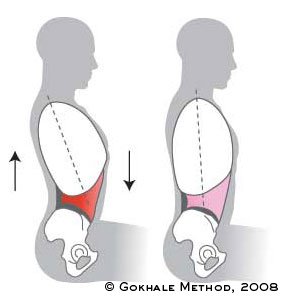
Though a sway back is commonly perceived as good posture, most people recognize it to be a problem. What is the best way to fix a sway? And for those of you who don’t quite know, what is a sway?
A swayback is an inappropriate curve usually in the upper lumbar spine. It is frequently the result of trying to “sit up straight,” or “stand up straight” in a sustained way. Sometimes it is the result of modern activities, most notably women’s gymnastics, women’s ice-skating, women’s ballet and misguided forms of yoga.

At the end of his rope after chiropractic, physical therapy, massage and surgery, a Transportation Planning Consultant finds relief with Gokhale Method Foundations Course.
Travis Dunn, PhD, remembers clearly the onset of his excruciating back pain. He was all of 24 years old.
“It first appeared while I was on vacation in June 2005,” he recalls. “There was no specific, major incident that precipitated the pain, but it grew sharper and more debilitating over the course of a week or so, including occasional sciatica.”
He would start each day with his back pain registering “one or two” on a scale of ten, he recalls. As soon as he sat, the pain would grow worse. “If I were to remain seated, I’d be at seven or eight within a half hour. When I stood up, I would be like a hunchback.”