
Karen's Yoga Success Story
Several years ago, I was struggling with sleep apnea, knee pain, and chronic neck pain from an old diving injury—all despite my committed yoga practice. Something was missing. When I found the Gokhale Method®, I experienced a profound shift. My pain reduced. My stamina increased. I felt calmer, more confident, more capable in my body.
I was so inspired that I went beyond practicing the Gokhale Method that I had learned with my teacher, Lang Liu. We became friends, and I then studied with Esther Gokhale to become a qualified Gokhale Method teacher myself. At 80+ years old, that felt like finding treasure at what some people might call the end of the rainbow—but to me, it feels like a new beginning.
The Gokhale Method transformed my yoga practice
I started practicing yoga at about 30 years old, and a couple of years later took a yoga teacher training in Toronto. The training drew on representatives from different yogic traditions, the asana aspect being from B.K.S. Iyengar, who is widely regarded in the West as the father of modern yoga. I enjoyed teaching yoga for a few years before I began a job as an ESL (English as a Second Language) teacher in the school system.
As a Gokhale Method teacher, when I now look at photographs of Iyengar in the asanas (postures), I notice that he mostly backbends at L5-S1, not in the upper lumbar area, which remains straight.
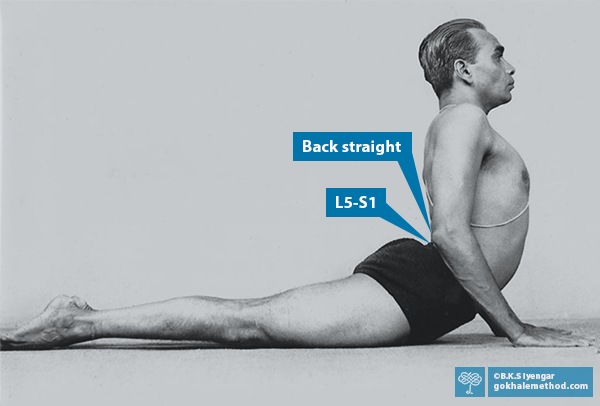
Here you can see B.K.S. Iyengar in cobra pose. He keeps his back straight, with the exception of deep articulation at the lumbosacral junction. The significance of this L5-S1 angle has been largely overlooked by his students. Yogavanpoll(B.K.S Iyengar)
As for Iyengar’s forward bend poses, movement is maximised by the rotation of the pelvis around the hip joint before any spinal flexion takes place. Two of the seniors I taught had quite a pronounced thoracic rounding, and I was amazed at how a combination of Gokhale Method techniques enabled them to become much straighter in the upper back.
If you've practiced commonly taught yoga poses, you'll likely notice that Gokhale Yoga is distinct. Many yoga classes move you between rounded bends (deep flexion) and backbends (strong extension). What I have come to realize is that this can result in deepening the already exaggerated lumbar and thoracic curves in an S-shaped spine. In this scenario, an already rounded upper back tends to further overstretch its spinal ligaments, while an already concave lumbar area becomes tighter and more compressed. The way cat-cow is typically done in a yoga class is an example of this. In Gokhale Yoga you won't alternate between extreme positions that risk aggravation.
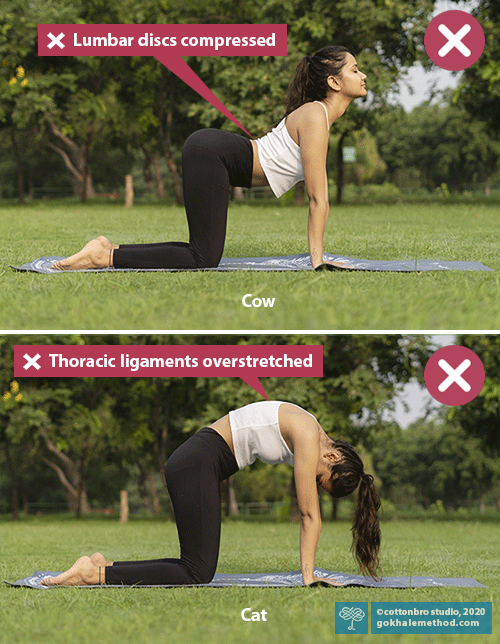
Cat-cow is widely considered to be a good mobilizing exercise for the spine—but there is a big downside. Pixahive
The use of props
Iyengar was also an early innovator of props when a student could not otherwise maintain healthy alignment in a pose. Our Gokhale Method products, such as the Stretchsit® Cushion and the Gokhale® Wedge, are based on similar therapeutic principles but instead of supporting yoga poses they support everyday poses.
Benefits beyond the mat
I love how the principles of healthy alignment apply both on the mat and beyond. The patterns you learn in yoga postures become immediately useful whether you're walking, sitting, bending over, or standing in a queue. Movements in yoga embody principles drawn from efficient, real-world posture: the J-shaped spine, posterior-set shoulders, and natural leg and foot angles. Few yoga or wellness classes offer this level of practical carryover into everyday movement.
The strength and flexibility partnership
Many people come to yoga seeking flexibility, but flexibility without strength is passive and potentially destabilizing. Strength turns flexibility into safe, functional movement.
I discovered the value of strength poses because of a health issue. In my many years of yoga practice I had been doing a lot of inversions—I would even say I was addicted to them! When I developed glaucoma, I was told to eliminate inversions and breath-holding, including downward dog and forward bends.
Unwilling to give up my practice, I then focused on standing and other poses that didn’t turn me upside down. Most were strength-focused postures rather than flexibility-oriented, and included balances—all of which I discovered I was weaker at! It made me realize I should have been doing more of these all along. Some examples are: tree pose, chair pose, plank, side plank, warrior poses, and half moon pose.
About eight years ago, I added a Gokhale focus to my yoga practice which exponentially improved my strength and stamina—with the bonus of significantly improving my neck and knee issues!
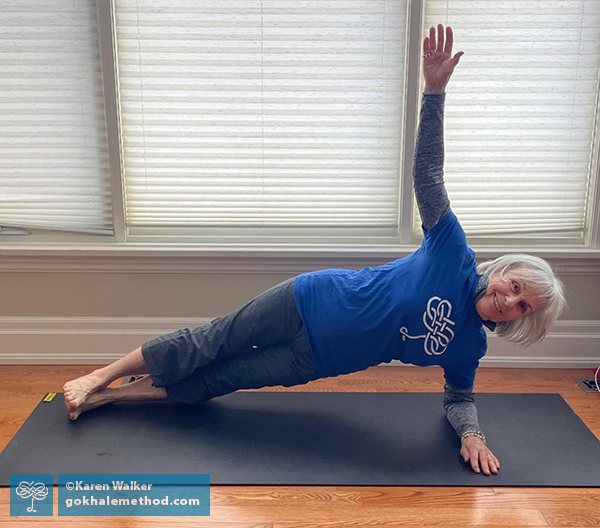
Here in side plank (Vasiṣṭhāsana) I am working my inner corset and shoulders hard—we teach modifications to steadily build the degree of challenge.
I also appreciate the meditative aspect of the Gokhale Method—bringing your attention to the present moment through awareness of your posture. This self-awareness is a key ingredient in yoga and encourages you to think of your body as your temple, something that needs to be cared for by you. Yoga and the Gokhale Method form a natural, complementary partnership.
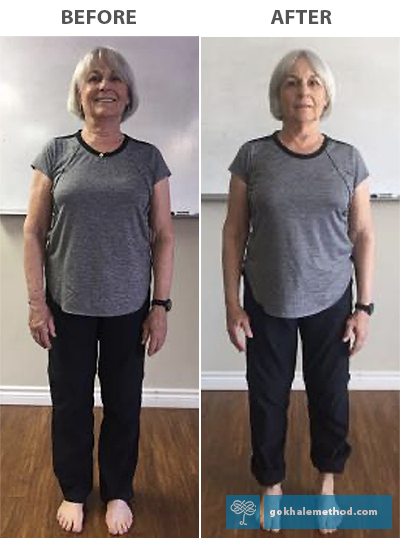
The Before and After photos from my Gokhale® Foundations course show I came to stand with more awareness, symmetry, and better support. In Gokhale Yoga, we are even more interested in how to stand well on our feet than how to stand on our heads!
Aging well in gravity
I've seen many folk with posture issues who could benefit from this work—sometimes they resist. They think it's too late. They've accepted their limitations as inevitable. But here's what I've learned: we live in a sea of gravity. How we move and rest in it matters. The Gokhale Method helps us to healthily align our bones with that force and thrive as we age, rather than be burdened by it.
I’m concerned about those taking up yoga—or any physical activity—without these biomechanical principles in place to protect themselves. I see people jogging and hurting themselves with every step. For older people the stakes are even higher: they’re more likely to have existing wear and tear, and are slower to heal from injury. Then sometimes they give up exercising altogether!
Aging well physically isn't mostly luck—it's about maintaining good form and consistency. Students of the Gokhale Method acquire what I call a "postural toolbox"—a collection of techniques supporting physical health, mental clarity, and emotional well-being. You develop a longevity mindset.
Your body isn't fragile—it's adaptable, resilient, and capable of remarkable things. I'm living proof that vitality and strength don't have an expiration date. As an artist, gardener, hiker, and golfer, I bring my yoga and Gokhale Method awareness into everything I do. This awareness relieves pain, increases vitality and stamina, and lets me approach life with joy.
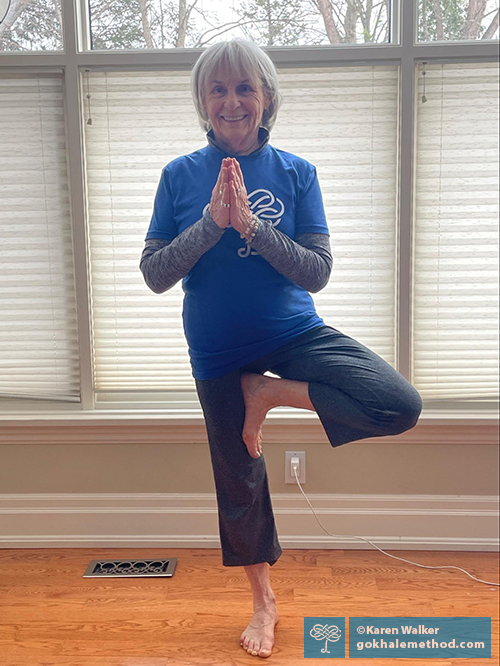
Tree pose (Vṛkṣāsana) helps to develop balance and strength in the legs and stabilizing muscles—and a sense of fun!
I’m excited to share not only my personal story but an invitation to join me. On Thursday, January 15, is the first of three Thursday Gokhale Yoga sessions that I am teaching with Lang, starting at 7:00 a.m. PST.
These sessions are part of our exciting New Year Strength Challenge in Gokhale Fitness and Gokhale Yoga. It’s not too late to join the fun—we’re just four days in. Come at whatever level is right for you, and feel stronger and happier in your body come February 1. You can find out more and join me by subscribing to Gokhale Active here.
Best next step
Join any one of our upcoming FREE Online Workshops using the sign-up below.
Comments
Karen you are inspirational…
Karen you are inspirational. Thanks for the insights that you shared, such as many yoga classes moving between rounded bends (deep flexion) and backbends (strong extension) and how this can result in deepening already exaggerated lumbar and thoracic curves in an S-shaped spine. I wouldn't have thought of this but have been reviewing the strength and mobility work that I do applying common sense and listening to my body to see whether I should alter my exercise practice.
Karen… you are such an…
Karen… you are such an inspiration. I especially liked your breathing techniques when you substituted for Lang. “Gravity plus breathing equals healing” is something I read years ago and have taken as one of my mantra.
When I first encountered the GM, I was struck by the perfect logic if you beanshape and extrapolate what that means throughout the rest of your skeletal system. Then as you said, since we live in a “sea of gravity”use gravity strategically and you can coax your skeletal system into better alignment over time.
Just apply Newton’s 3rd Law of Motion where you have blockages that are inhibiting your alignment and peck away until they recede. Don’t fight gravity – use it to your advantage to avoid friction until you get proper alignment. The GM gives you the best template into which you can aspire to sculpt your body from the inside out 24/7 without ever having to leave your house.
Thanks again, for the inspiration. You are proof that you can teach an old downward dog a new trick. Modification is the name of the game.
I also love when you are able to come to 123 because we have an extra example of good form to watch.
Add New Comment
Login to add commment
Login