
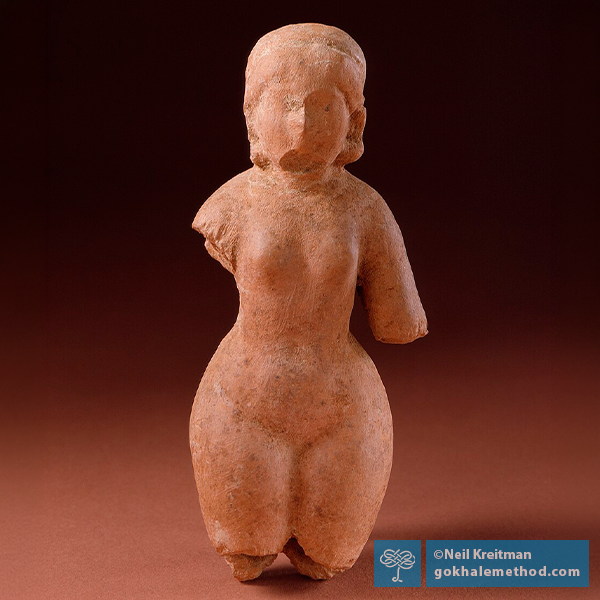
Over the years, aside from improvements in pain levels and posture, I’ve witnessed many students experience unexpected health transformations—improved digestion, relief from painful periods, the end of incontinence worries. Once we understand what is happening structurally inside a tucked pelvis, this actually makes sense.
Tai Chi, Qigong, and Tucking the Pelvis
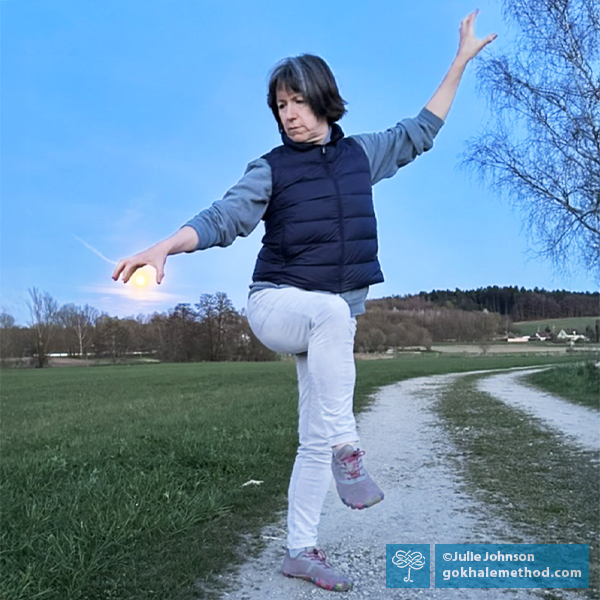
Our teachers often field questions about tucking the pelvis for Tai Chi and Qigong. It is frequently perceived that Tai Chi recommends tucking the pelvis as part of a baseline stance, purportedly to facilitate “the Qi to flow unimpeded.” It’s a central tenet in Gokhale Method® philosophy that the baseline pelvic position be anteverted, and that tucking the pelvis is a “wrong turn” Western society took about a century ago (think flapper posture). So students who encounter a seemingly exactly opposite guideline or model in Tai Chi are understandably confused.
Playing the Organ with No Pain and More Musicality
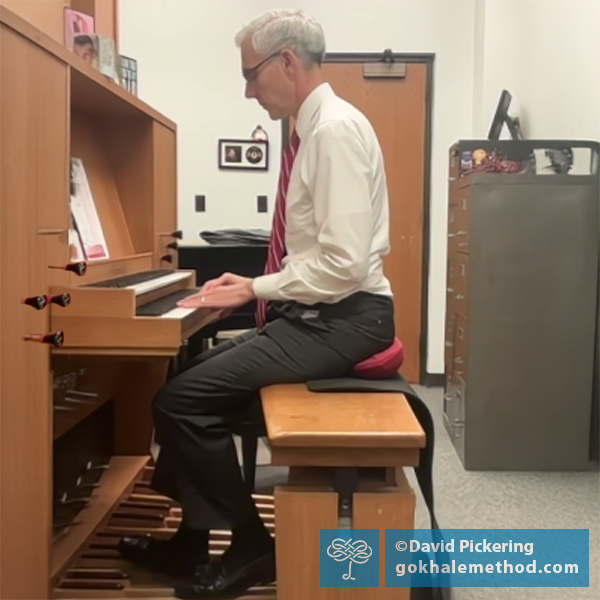
I came upon the Gokhale Method® very much by chance. Years ago I worked with a pianist named Sheila Page who was trained in a technique which was founded by the American music teacher Dorothy Taubman. Taubman observed people with high levels of playing ability, found out what they did so well, codified it into a method and taught it. At a Taubman workshop I heard of Peter Egoscue, who had devised a therapeutic exercise program; I worked from his book when I hurt in places, and had some improvement with that. Doing further research for pain relief, I then encountered Esther Gokhale’s name. Not too long after, my son and I drove together to attend a one-day Immersion course Esther was teaching in Boulder, Colorado.
The Gokhale® Wedge 2.0
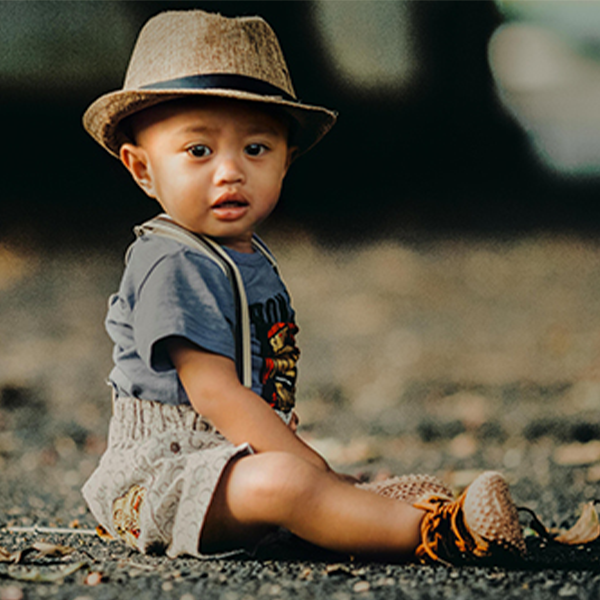
In Spring last year we launched the Gokhale® Wedge. For years, our students have been requesting a convenient, ready-made wedge for upright sitting without a backrest, one that doesn’t require folding blankets and other makeshift (pun intended) measures. The requests also specified an attractive item to enjoy around the home or office, and that it be of durable quality, keeping its shape and good looks with daily use.
Posture Tips for Meditators
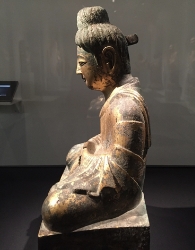
It has been over 60 years since Eastern schools of meditation became widely known in the U.S. and Europe, and meditation became widely practiced, with over 14% of Americans having meditated at least once. If we include those practicing mindfulness techniques, using meditation apps, and attending yoga classes with a meditation component, this figure goes far higher.
The effects of sitting in meditation
The potential benefits of meditation are well known, and include a calmer, clearer mind, lower levels of stress, better sleep, improved relationships with others, and better mental health.
From a posture perspective, whether you sit in meditation regularly or are just getting started, you want the experience to be as healthy for your body as it is for your mind.
Ronald Katz’s Gokhale (Gō-clay) Method® Success Story

Before I settle in to recount my back pain story, let me fetch my Gokhale Pain-Free™Chair. This is the chair I now use for all my writing, and that’s important, as I am an author of mystery short stories, and spend many hours composing at my desk. Pain-free, I’m now glad to say.
Five Posture Tips to Power Your Cycling
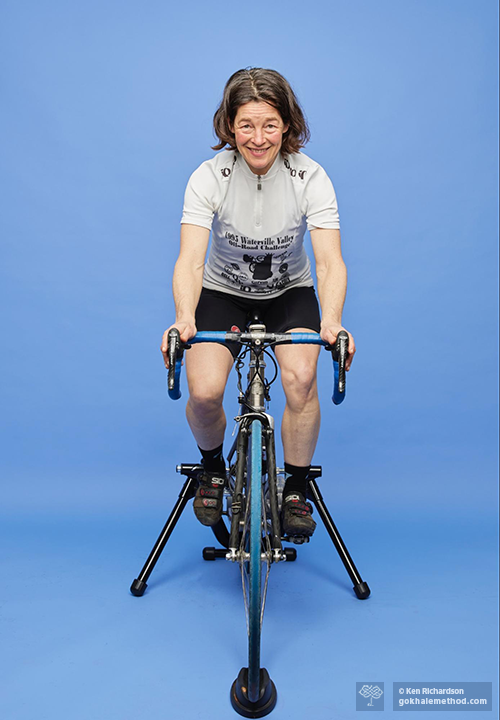
This is Part 3 of a three-post series on cycling with healthy posture by Gokhale Method teacher and longtime cyclist Tiffany Mann. Read Part 1 and Part 2 here.
Spring has arrived, and perhaps like many people, you want to spend more time on your bike! Maybe you’re already an avid cyclist looking for some tips to make cycling more comfortable and sustainable for years to come; or you’ve taken a break and are ready to step back on the pedals. Perhaps you just want to get up those hills!
Even if you are a beginner, it is so satisfying and pleasurable to use your own muscle power to propel yourself on this simple machine; but it is still well worth looking at how to use your energy as economically as possible. Cycling doesn’t have to be superhard work, and you can benefit your posture at the same time.
Can the Venus of Willendorf Teach Us about Posture?
Thought to have been made around 30,000 BCE, one of the oldest and most famous prehistoric figurines is known as the Venus of Willendorf. Found in modern-day Austria, this late stone-age artifact is just over 4” high and has traces of ocher coloring. Underneath her ample flesh her pelvis is anteverted, placing her behind behind her. Original image courtesy Wikipedia user MatthiasKabel under CC-BY 2.5.
When the weather is cold and wet, or, for our students in the Southern Hemisphere, hot and dry, museums can be very agreeable places to visit. Humidity and temperature controlled as they are, museums allow you to study posture history in comfort!
A central principle of the Gokhale Method is an
Posture Differences in Elite and Plebeian Ancient Egyptians
This famous bust of Nefertiti (c. 1370 – c. 1330 BC) exhibits a forward-protruded head. Original image courtesy Wikipedia user Philip Pikart under CC-BY-SA 3.0.
In my travels, I enjoy visiting museums. In a concentrated space and in a short few hours, I am able to travel back in time and over large distances, and compare people from different cultures. What a remarkable gift from the craftspeople of the past!
Many museums have a well-developed Egyptian collection. The Egyptians’ expertise in preserving their dead as well as the dry Egyptian climate has yielded a bounty of specimens from the distant past. Egyptian artifacts are often spectacular and modern audiences are drawn to Egyptian
How to Sit on the Floor, Part 1: Cross-legged Sitting
This is the first post in our multi-part series on floor sitting. For Part 2 on squatting, click here.
Sitting cross-legged on the floor is common in many cultures around the world, and has become popular in some segments of modern Western societies.
This Druze woman who I met in Israel has sat cross-legged all her life. She runs a hospitality business — all the food is laid out on the floor and the guests sit along the periphery of the room. She is at ease in this position for extended periods with her back remaining upright and relaxed.
In this temple in Bhubaneswar, devotees sit cross-legged for extended periods in performing rituals.
These Buddha figures in Thailand show relaxed, healthy