
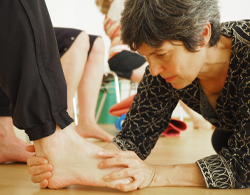
Why is it not a routine practice for podiatrists to observe their plantar fasciitis patients’ stance and gait? Let’s consider how a broader approach that considers the way people stand and walk could improve treatment outcomes for plantar fasciitis patients—and also help prevent recurrences.
How To Go Down Stairs (Part 2)
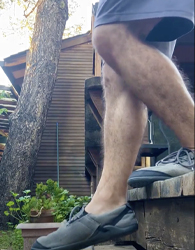
Welcome to our second post on navigating steps and stairs. Our first post looked at how to power yourself up stairs—however, we often hear from our students that their most pressing concern is how to come down stairs.
Are you starting to worry that you may need to set up your bedroom downstairs, or find yourself compromised when visiting places with stairs? Perhaps you have a friend or older relative in this position? Is it possible to maintain or even improve your fitness and mobility in the years ahead? “Life exercises” such as descending stairs, done skilfully, can be transformative and can give many benefits beyond getting you where you want to go.
The New Year 3 x 3 Fitness Challenge: Strength without Strain
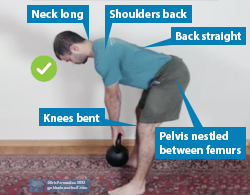
We’re here to help with your New Year’s fitness resolution. Join us for a FREE 10-day New Year 3 x 3 Fitness Challenge, which is offered as part of the Gokhale Exercise program. It will be fun, safe, and effective, enabling you to build your strength without strain and injury, because, all the while, you are also training for healthy posture!
The Best Way to Strengthen a Muscle
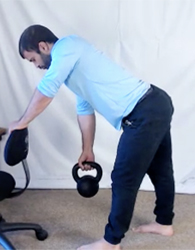
Using the word “eccentric” might sound like I’m about to write about muscles behaving in weird ways that are different from usual muscle behavior!
But what I’m referring to, eccentric muscle contraction, is often pronounced ee-sen-trik, not ek-sen-trik.
How muscles contract
Eccentric muscle contraction is the reverse of the concentric contraction that we typically associate with muscle training. For example, the dumbbell curl that makespops up the bicep prominent as you lift the weight towards your shoulder is a concentric contraction. The muscle contracts and shortens. But lowering the dumbbell back down again, which requires the muscle to lengthen, also takes
Gliderunning: Part 2: Meet Your Feet
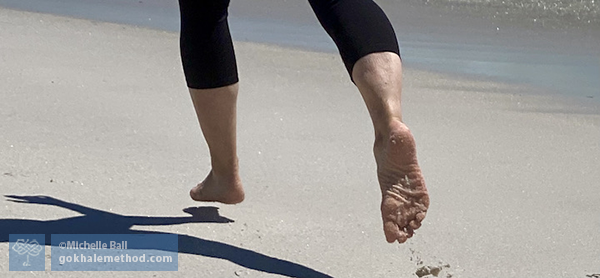
Welcome to the second blog post in our series on running. This series is designed to be useful to beginners and would-be beginners, as well as seasoned runners and everyone in between. If you missed Part 1, you can catch up here.
Reactivate your feet
When it comes to advice about running, the feet often get overlooked as the subject immediately turns to shoes. While shoes are an important subject (spoiler alert! Part 3 is about shoes), I prefer to start with that miracle of bioengineering that actually does the work—your feet.
Our feet become very passive from walking on flat, featureless surfaces rather than natural, more undulating terrain. They are also constrained, misshapen and deconditioned by less-than-ideal footwear, which, sadly, includes many running shoes on the market.
How to Sit on the Floor, Part 2: Squatting
This is the second post in our multi-part series on floor sitting. For Part 1 on floor sitting, click here.
Why squat? Squatting isn’t something we do much in industrialized societies beyond childhood, but if you can do it healthfully, it is an eminently practical posture for resting the body while keeping the backside elevated off the ground and the clothing clean, as this woman from Orissa demonstrates.
This woman from Orissa demonstrates a healthy, full squat with foot arches intact and a long, straight spine.
It is also the posture used for toilet activities in places with floor toilets, a trend which has recently made its way to the industrialized realm in the form of popular footstools