
How We Lost Our Pelvic Swing (And How To Get It Back)
In my last blog post, we explored what happens inside the body with a chronically tucked pelvis — the compression of organs, the overburdened pelvic floor, and the cascade of health consequences. Today I’m asking: why is healthy pelvic movement an integral part of some cultures and not others? And how can you get back in touch with your natural range of movement?
A tale of two postures
When I travel and observe people in traditional, non-industrialized communities — in West Africa, rural India, and indigenous communities in South America, for example — I consistently see a naturally anteverted pelvis, easy hip mobility, and a fluid, swinging gait. The pelvis is not held rigidly; throughout everyday activities, it swivels, rocks side to side, and generally enjoys unrestricted movement.
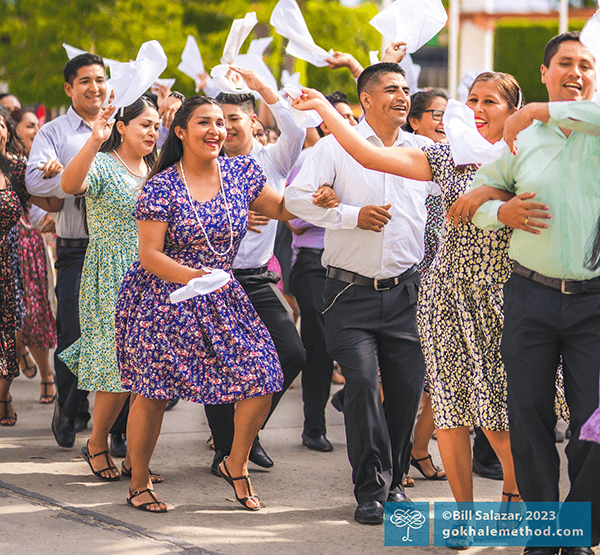
Lateral hip movement is common in most parts of the world. Here, pelvises move freely as people celebrate a summer festival in San Martín, Perú. Image from Pexels.
Contrast this with much of modern Western culture, where the pelvis rarely moves, except in a forward-and-back direction. Why? The answer is that this particular part of our anatomy has been caught in a tug-of-war between suppression and hypersexualization — with very little room left for natural, functional movement.
Pelvic movement has accumulated centuries of moral baggage. Swinging hips or a relaxed and mobile pelvis can be perceived as inappropriately sexual, immodest, or lacking in self-control. Many women students, in particular, describe having been told, explicitly or implicitly, to still themselves: to walk with smaller steps, less swing, to hold the lower body in check. The body learns these lessons well. What begins as a social instruction becomes a muscular habit.
The result is a culture in which pelvic movement has become something to be reined in rather than expressed. A source of embarrassment rather than what it actually is: the natural movement of a joint that is crucial to healthy gait and overall function.
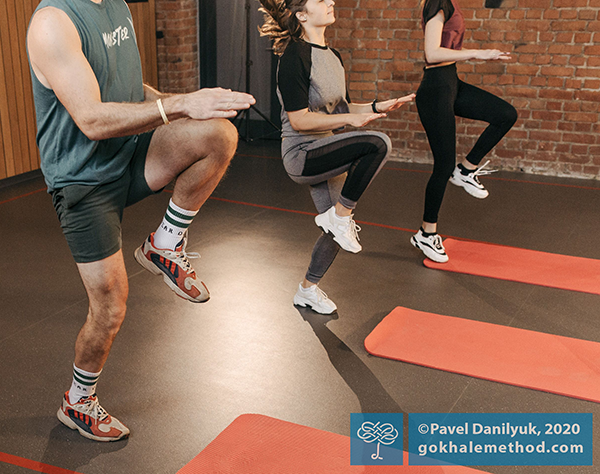
Most common fitness activities in our culture provide ample forward and backward movement for the pelvis. How can we take care of our need for lateral movement? Rotational movement? Movement in all directions? Image from Pexels.
The biology of a mobile pelvis
When we walk with a natural fluidity in the hips — what I call glidewalking — the muscles around the hip joint — the gluteus medius, the external rotators, the iliopsoas — engage rhythmically, pumping blood and lymph through the pelvic cavity. This circulation nourishes the pelvic organs. A pelvis that moves is a pelvis that “breathes.” A pelvis held rigid or tucked is a pelvic area that stagnates. We have medicalized what goes wrong inside a tucked pelvis — the incontinence, the prolapse, the painful periods — while largely ignoring the postural pattern that may underlie them.
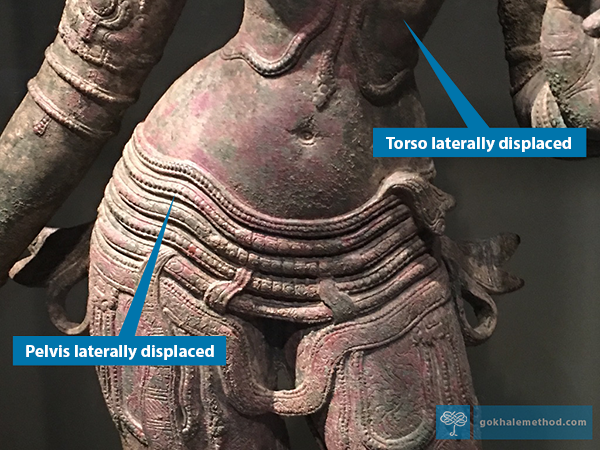
This 12th century Chola statue of Bhudevi at the Boston Museum of Fine Art shows healthy lateral moves in the pelvis and torso.
Alt text: 12th century Chola statue showing healthy lateral movement in pelvis and torso.
What dance can help with
Salsa, cumbia, merengue, belly dancing, and samba all originated in cultures where pelvic mobility is seen as entirely natural — and often celebrated. The characteristic hip figures in these dances require the pelvis to be free in all three planes of motion, and the weight to transfer rhythmically from foot to foot in a manner similar to healthy walking.
Practiced regularly, these movements reinforce what we teach in the Gokhale Method: they mobilize the hip joints and gently condition the muscles that support healthy pelvic architecture. The dance floor, it turns out, is not a bad place to begin reclaiming what modern posture habits have taken away.
You need not become a professional dancer. Even a few minutes a day of free, rhythmic hip movement — letting the pelvis swing and rotate as it was designed to — can begin to reverse years of habitual pelvic tension, and improve your gait.
Reclaiming your pelvic freedom
The pelvis is designed to move. Its architecture allows it to move freely in all three planes of motion—forward and back, side to side, and in rotation. Dancing and glidewalking naturally exercise all three. People in communities that have preserved these movement patterns appear to retain greater pelvic mobility, and many of the health benefits that come with it. For the rest of us, it requires a little unlearning. The good news is that the body is usually remarkably willing to remember.
Free Workshop July 3rd
Interested in learning more? Join the Pelvic Freedom: A Tucked Pelvis Is a Stuck Pelvis workshop — with myself, Dr. Nam Lee, and Dr. Melissa Fernandez. It’s free and live on Zoom at 12pm Pacific on Friday, July 3, (or register to receive the recording if you can’t make it live). We’ll explore the benefits of pelvic freedom in more detail, and dance together.

Comments
Add New Comment
Login to add commment
Login