
Good Posture Is Not What Most People Think
May is Posture Awareness Month. This gives us a fine opportunity to check in with how we hold ourselves. Of course it’s important to understand what good posture is, something that is shockingly lacking in modern times. Once we understand healthy posture conceptually, awareness and checking in can do wonders for our health and vigor.
We begin life with all the ingredients needed to become highly functional—but we also depend on the culture to set healthy movement habits. Unfortunately, in modern industrial societies, the culture no longer supports us this way. The design of modern clothing and furniture, and posture guidelines like “sit up straight”, “chin up”, “chest out”, etc., do more harm than good. And so we have landed up with high levels of pain, dysfunction, and the costs that go with that.
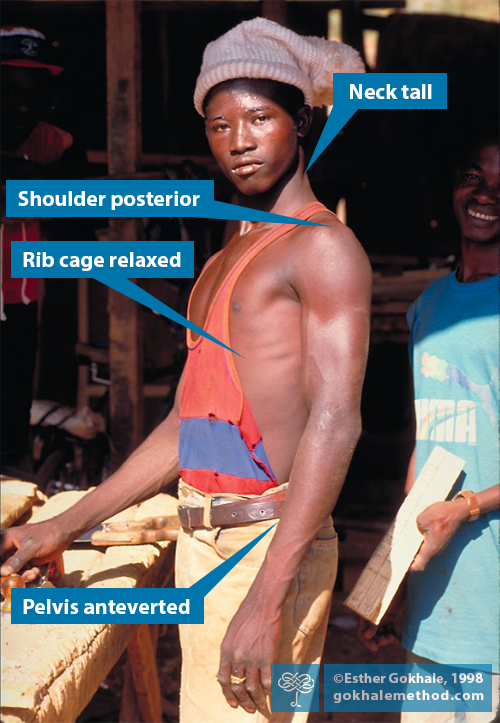
We are born with a blueprint for beautiful, healthy posture. Upright and relaxed is our birthright.
A misconception—posture as a pose
When people discover I am a posture teacher, they often respond by pulling their shoulders back, and stiffening to lift their chest and chin. This common reaction reveals a widespread misconception—that good posture is something you have to make an effort to hold. A position you impose on your body. A kind of performance.
Yet holding a pose requires tension. Muscles grip, and the body tires quickly. It is not sustainable. Nor is it healthy.
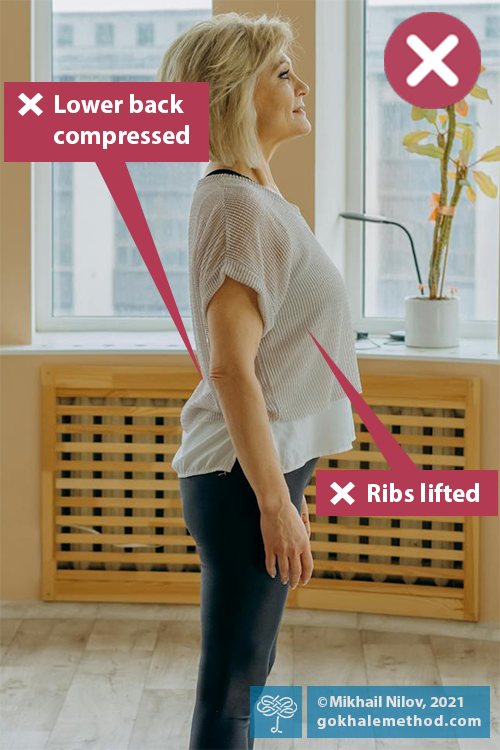
While well-intended, the common “stand up straight” pose creates muscular tension and spinal compression. This woman is also locking her knees and groin, which creates additional problems.
If upright posture feels effortful, rigid, or strained, it is likely not “good” posture at all, but a hack needed to work around a lack of understanding of the laws of biomechanics.
Upright and relaxed—a different standard
Truly good posture has a different quality altogether. It is both upright and relaxed. When you stand or sit the way the human body is meant to, the bones stack in a way that allows the body to support itself with minimal muscular effort. The spine is long and protected, the shoulders rest comfortably back, and the bones receive the healthy weightbearing they need to prevent osteoporosis. Breathing is easy. The body emanates well-being.
When we observe traditional cultures or young children, we consistently see posture that is open, upright, and at ease. There is no stiffness, or forcing—just natural alignment that obeys the laws of gravity and biophysics.

This child’s posture is upright, open, and at ease. This is our natural posture as humans.
Why awareness alone isn’t enough
Simply becoming aware of posture is a valuable first step. But, if our sense of what is “good posture” is inaccurate—as it often is—then awareness can lead us to reinforce the very patterns that cause discomfort. This is where education becomes essential.
Learning to recognize the hallmarks of healthy posture—such as an elongated spine, an anteverted pelvis, and shoulders that rest toward the back of the torso—can be transformative. These details can be easy to miss without trained guidance. In addition, what feels “right” to someone may not be aligned with what is actually beneficial. Students sometimes report that the new postures feel counterintuitive. Indeed, if you have spent several years straining backward to be “upright”, being truly upright can feel slumped until your brain adjusts.
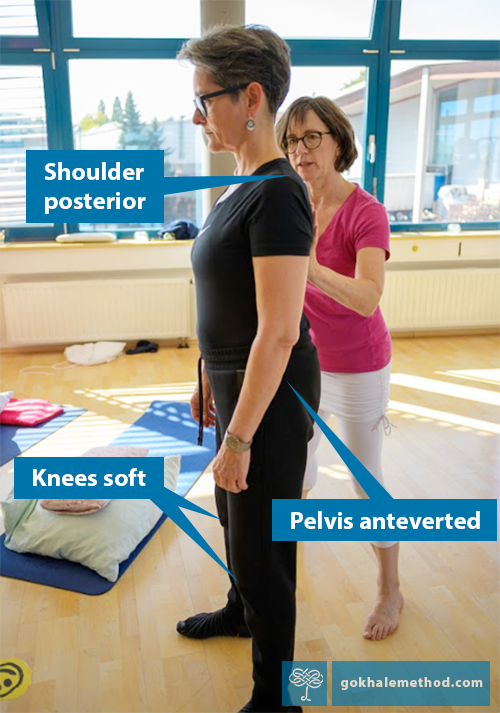
Gokhale Method teacher Julie Johnson guides her student in tallstanding, with all the hallmarks of truly healthy posture.
Working with a trained teacher can help refine your eye and your sense of where your body is in space—your proprioception. Gentle, precise adjustments, and encouragement to persevere can allow you to make remarkable postural transformations.
Posture as a way of life
Ultimately, posture is not a position—it is a set of habits. The goal is not to constantly think about how you are sitting or standing. Rather, it is to cultivate new patterns that become automatic. To integrate healthy alignment into the fabric of everyday life—the way you sit at your desk, walk, sleep. You no longer have to “remember” to have good posture—it simply becomes your new normal. When good posture becomes habitual, many benefits accrue. Muscles that were overworked can relax. Structures that were compressed can decompress. Comfort replaces strain.
Looking ahead (with a well-aligned neck)
In our next blog, I will share some simple techniques you can try for yourself—practical ways to experience this upright ease in your own body.
Until then, I invite you to notice not just whether you are aware of your posture, but what you believe good posture to be.
Best next step
Join a free online workshop below to learn what truly healthy posture looks like.
Comments
Add New Comment
Login to add commment
Login