
If you are suffering from back pain, the most likely reason for it is hiding in plain sight. Like most people, including your medical and complementary health professionals (!), you are just not trained to see it. The root cause of most musculoskeletal problems, whether it be lower back pain, a frozen shoulder, neck pain, plantar fasciitis, or a knee issue, can usually be detected in your posture and your resulting movement patterns.
Tom Carter’s Back Pain Success Story

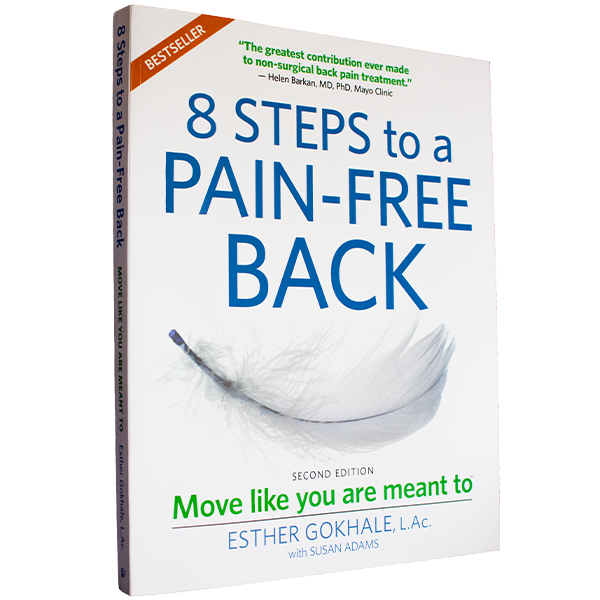
I’ve been doing therapeutic bodywork and massage for 25 years. One of my clients, who owns the garage that services my car, had trouble with his hip—I did what I could to help. About a month later he came back, and was walking much better. I asked him what had happened—and he told me he had taken some Gokhale Method® classes. Intrigued, I ordered Esther Gokhale’s book.
Kathy Nauman Success Story
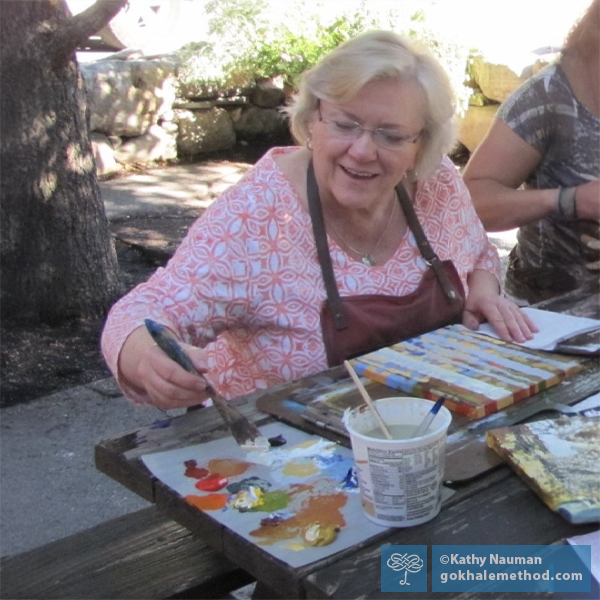
In 2014, at age sixty-four, I began to experience pain in my left hip that eventually became quite debilitating. For the first time in my life, I went to a chiropractor, which resulted in relief that lasted a couple of years. By 2015 I had consulted first one, then a second orthopedic surgeon, who recommended a hip replacement due to osteoarthritis.
Sheila Bond’s Back Pain Journey
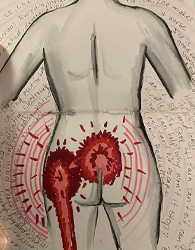
My name is Sheila Bond, and I am an artist, knit and jewelry designer, and an art teacher. I am also the mother of four sweet kids. In this blog post I would like to share with you my Gokhale Method® journey out of pain and despair.
On May 6 2022 I severely herniated the spinal disc between my L4/L5 vertebrae. In addition I had developed bursitis in my left hip during the previous three months, I believe from sitting improperly teaching online classes.
It happened on the Friday before Mother’s Day. By Saturday morning I could barely move and thought I might die or at the very least never recover. I ordered a TENS unit (transcutaneous electrical nerve stimulation, a mild electrical current to give pain relief) from Walgreens, bought Salonpas patches too, and a walking cane. I took three Advil or two extra strength Tylenol alternating every six-hours hours.
I had previously herniated my L4/L5 in 2015, and had a laminectomy (a surgical operation to remove part of the back of vertebrae, usually to relieve pressure on nerves.) That surgery had left me still in terrible pain. When I told the surgeon I was still in pain in my tailbone/sacrum area, he told me he could operate on my tailbone. I declined. Following surgery I also went to physical therapy for a year and a half. It gave me more pain than it took away.
How Not To Do Yoga
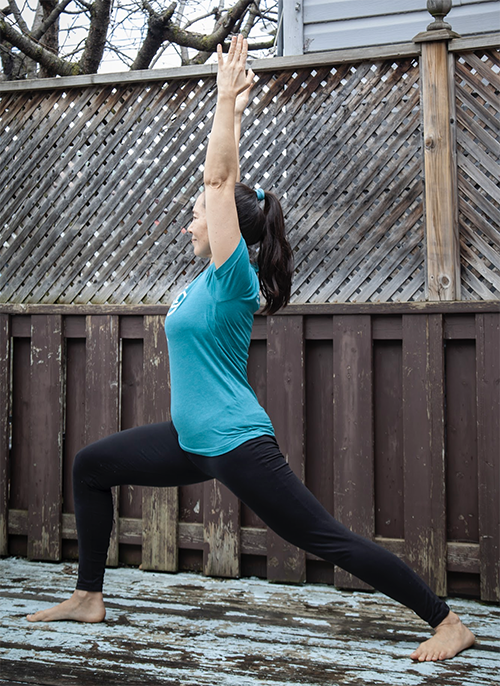
This blog post explains how some common yoga injuries occur and how applying the principles of healthy posture to yoga postures replaces this scenario with movements that are good for your body.
Yoga postures and back pain
Growing up in Mumbai, India, my Dutch mother was a student of BKS Iyengar and the Satyananda yogis, and keen for me also to learn yoga asanas, or postures. I practiced, and, being reasonably athletic as a child and already trained in Indian classical dance (Bharata Natyam), did not find it particularly difficult to choreograph the back bends, forward bends, and twists that were asked of me. I became a yoga model, demonstrating postures alongside visiting swamis’ presentations to induce the audience to sign up for upcoming yoga courses.
"I Know What It's Like to Lose Hope:" Anissa's Posture Journey
Anissa Morgan is 46 years old and was born and raised in San Antonio, Texas. In her own words, her relationship with her body has “always been a little messed up.” She didn’t like how she looked. Growing up, her mom frequently told her that she was slouching and "should pull her shoulders back," anecdotal posture advice many of us have heard.
In adulthood, Anissa spent some time in the Army Reserves as a petroleum specialist. The military approach to posture reinforced what she’d heard from her mom in childhood: that she “shouldn’t be slouching and that everything should look ‘a certain way.’” In her job, she would deliver fuel to military vehicles such as airplanes, cars, and trucks. She
Abigayil Tamara's Experience with the Gokhale Method
We set a high bar for our six-lesson Gokhale Method Foundations course. We expect our students will
Sit, stand, walk, lie, and bend in new (old!) and better waysExperience significantly less pain and more functionExpect more from their body and life. Use the word “life-transforming” somewhere in their evaluation forms.Even with this high bar, a student sometimes surprises us with the extent or speed of their progress over the course. Abigayil Tamara is one such student - here is her story.
My Experience With the Gokhale Method
~Abigayil Tamara, MA, MSW
I looked into the Gokhale Method after someone in a grocery store told me how much it had helped his mother.
My back issues began over 34 years
Posture Journey: Travis Dunn

At the end of his rope after chiropractic, physical therapy, massage and surgery, a Transportation Planning Consultant finds relief with Gokhale Method Foundations Course.
Travis Dunn, PhD, remembers clearly the onset of his excruciating back pain. He was all of 24 years old.
“It first appeared while I was on vacation in June 2005,” he recalls. “There was no specific, major incident that precipitated the pain, but it grew sharper and more debilitating over the course of a week or so, including occasional sciatica.”
He would start each day with his back pain registering “one or two” on a scale of ten, he recalls. As soon as he sat, the pain would grow worse. “If I were to remain seated, I’d be at seven or eight within a half hour. When I stood up, I would be like a hunchback.”