
What Space, Weightlessness, and Gravity Teach Us About Spine Health
On April 12, 1961, Yuri Gagarin became the first human in space, changing our understanding of what the human body can endure. This week marks the 65th anniversary of that moment. Last week, NASA launched Artemis II from Kennedy Space Center in Florida, sending four astronauts around the Moon for the first time in over half a century. With space in the news, I find myself thinking about how weightlessness affects the human body—what it harms, and what it heals.
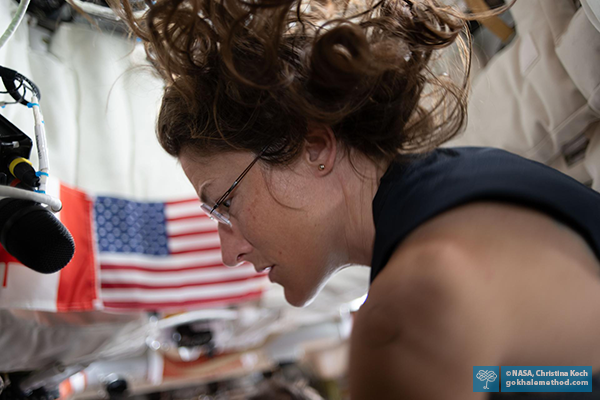
Artemis II crew member Christina Koch in microgravity on day four of their mission.
Bone health, osteoporosis, and weightlessness
Gravity, that great invisible force we sometimes complain about, is one of our skeleton's best friends. In microgravity, bones no longer need to support body weight, and the body—ever the pragmatist—stops maintaining them at the same level. The result is striking: astronauts typically lose around 1–2% of bone density per month in space, despite carefully managed vitamin D and calcium protocols. Postmenopausal women with osteoporosis lose roughly 1% per year on Earth, so space accelerates that process by a factor of twelve.
The lower body bears the brunt. The femur, pelvis, and lumbar spine show the greatest losses. The heel bone, too, needs to bear weight to remain healthy. The thoracic spine is a common site for osteoporosis on Earth, likely due in part to increasing thoracic kyphosis—a rounded upper back and forward head carriage—with age and stooped posture. It would be instructive to study thoracic bone density in astronauts who also no longer carry the weight of their heads as we were designed to.
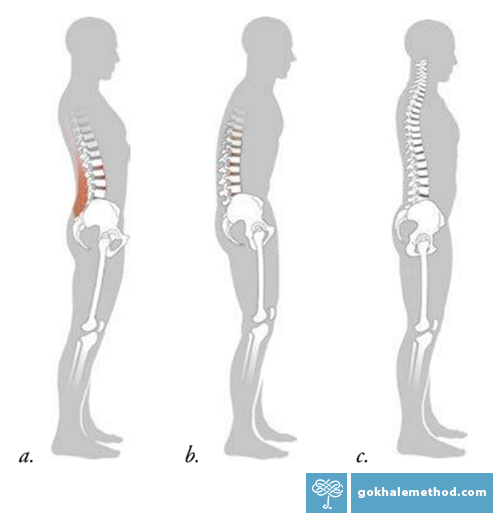
A swayed or slumped stance causes excessive tension (a) or collapse (b) in our relationship to gravity. It takes healthy posture (c) to align the bones and muscles for optimal weightbearing—and a tall spine. (Drawings from my book, 8 Steps to a Pain-Free Back.)
Resistance exercise equipment aboard the ISS has helped reduce bone loss considerably compared to earlier missions—a reminder that mechanical loading matters, wherever you are. For a Mars mission, however, with at least twelve to eighteen months in space, our present solutions may not be enough.
The spine is designed for gravity
Reduced bone density is not the only consequence of weightlessness. Without gravity's compression, intervertebral discs expand unchecked, and astronauts typically grow 2–5 cm in space. At the same time, the muscles, tendons, and ligaments that support and protect the spine weaken. Back pain is one of the most common complaints in orbit—a pointed reminder that the spine is designed to work with gravity and muscular support, not without it.
When elongating the spine is of benefit
Back on Earth, poor posture, a weak inner corset, and excessive spinal compression frequently cause back pain and degeneration such as disc herniation, nerve impingement, and bone spurs. The buoyancy of hydrotherapy and swimming pools is widely used by trainers and physical therapists to offer welcome relief from compression alongside strengthening the muscles we need to move and protect us. The limitation is that we spend most of our lives out of the water—sitting, standing, sleeping—and those are the hours where the spine either accumulates stress and damage, or needs to find a truly healthy arrangement.
The best of both worlds
We cannot live in a swimming pool, and most of us are not headed to the Moon. Fortunately, simply lying down with healthy spinal architecture allows our intervertebral discs to rehydrate through osmosis—a natural restorative process available to all of us, every night, provided we give it the conditions to work. I call this stretchlying.
But we can go further. The Gokhale Method® technique of stretchsitting uses an ordinary chair backrest to create gentle traction, offloading discs and nerves. Height is restored, and circulation around the spine is improved, all while you are driving, working at a desk, or watching a movie. Learning to use your inner corset muscles then protects and preserves this natural length. Gokhale Method techniques require no clinic visit and work within the hours you already have.
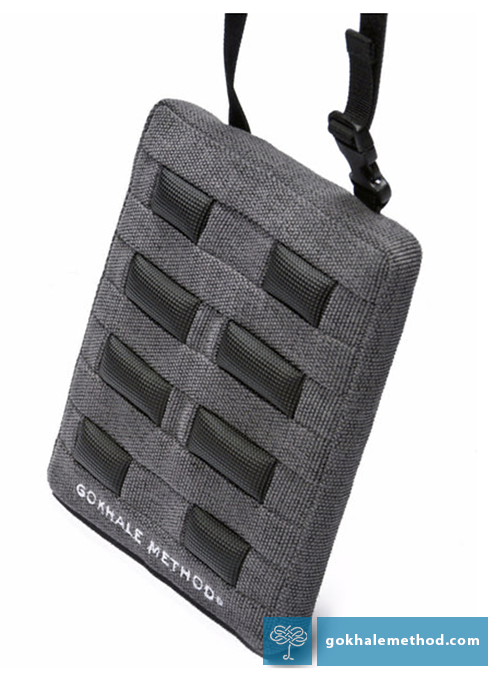
Use our Stretchsit® Cushion to tease out lower back sway and compression. It’s convenient, elegant, and fits your car seat and most other chairs perfectly.
Gravity is not the enemy. Compression without relief is. The spine is designed to bear weight and to recover from it, and these two work best in rhythm. Give your spine the room it needs and keep your bones well aligned in gravity—here on planet Earth.
Best next step
Join one of our upcoming FREE Online Workshops using the sign-up below—and learn more about how the Gokhale Method can help you to sit, stand, and move pain-free.
Comments
The effect of gravity and…
The effect of gravity and weight bearing exercise on the spinal column makes me question how weighted vests now being used affect bone density. I see it is a growing fad/trend when I take my daily walk. Would the loading exasperate poor posture problems or help strengthen core muscles and improve bone density?
Add New Comment
Login to add commment
Login