
Unlocking Olympic-Level Health: The Power of Downtime Training®
As the world tunes in to the Winter Olympics in Milano Cortina from February 6–22, we’ll marvel at skiers flying downhill, skaters carving ice, and athletes who’ve trained for years to make a few minutes look effortless. We know about the grueling workouts—in the gym, on the track, on the snow. What we rarely consider are the thousands of quiet hours in between: how these athletes sit, walk, stand, and recover when they’re not officially training or competing.
While most of us won’t be chasing Olympic medals, we do share one powerful training arena with these elite performers: our downtime. And yes, that includes how we sit on the couch while watching the Games. Downtime won’t earn us medals—but it can give us Olympic-level health. Athletic performance and lifelong physical well-being aren’t built only in workouts; they’re shaped continuously by the everyday positions and movements we repeat when we think we’re “doing nothing.”
In 2015 I taught three Gokhale Method workshops at the US Adult Figure Skating Championship in Salt Lake City. We worked on techniques and cues to keep the rib cage anchored, back straight, behind behind, and hips hinged—on the ice, and in their downtime.
The hidden training ground: your everyday life
How you move—and rest—during daily life isn’t just recovery from “real” exercise. It is training. Neurological and proprioceptive patterning—the way your nervous system learns movement habits—happens constantly. You’re always reinforcing something: either healthy, functional patterns or dysfunctional ones.
Take sitting. Sitting with a tucked pelvis compresses the L5–S1 disc, rounds the back, shortens the neck, and can aggravate the sacroiliac joints. Do this for hours a day, and no amount of gym work will fully counteract it.
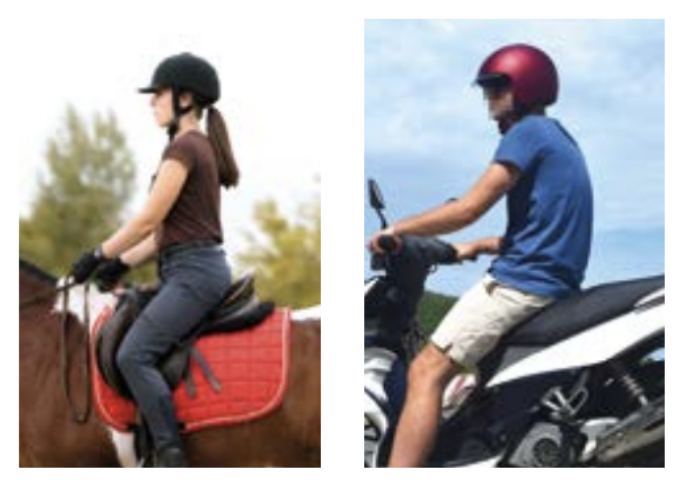
The 2nd edition of my book, 8 Steps to a Pain-Free Back, shows many new examples of healthy upright and relaxed sitting (left) and slumped sitting (right), which distorts and stresses the spine and its structures.
Most training programs focus on workouts, even though athletes—and non-athletes—spend far more time in everyday positions. Those hours can reinforce strength, alignment, and joint health—or quietly undo them. How you sit, bend, walk, stand, and rest between workouts, practices, games, or classes matters enormously.
This “downtime” zone is where your body spends most of its life. It shapes biomechanics, muscle balance, joint function, flexibility, stiffness, and long-term wear and tear. I call mindful attention to this Downtime Training®, and it often makes the difference between a body that holds up and one that breaks down.
Every step counts: an elite example
Consider Swedish long jumper Khaddi Sagnia. Elite athletes like Sagnia don’t excel solely because of what they do in formal training. They also benefit from excellent Downtime Training®—using healthy, natural form during everyday activities.
When Sagnia walks, her glutes are strongly activated, turning every step into a rep. Watch her walk down the track and you’re not seeing casual movement—you’re seeing preparation for running and jumping in real time. The same principle applies when you walk to the kitchen, climb stairs, or stroll the neighborhood.
Long jumper Khaddi Sagnia of Sweden uses her glutes to power the run up and propel her amazing jumping…and also to glidewalk away.
Ancient wisdom meets modern learning
My research into traditional populations revealed something striking: many people in these communities maintain excellent physical health well into old age, with very low rates of back pain—nothing like the roughly 80 percent lifetime prevalence seen in modern societies. This holds true whether their work is physically demanding or relatively sedentary, such as weaving.
These people don’t have gym memberships. What they do have is movement that aligns with how the human body is designed to function. Their everyday posture and motion support their bodies instead of quietly wearing them down. This ancient body wisdom serves them remarkably well across a lifetime.
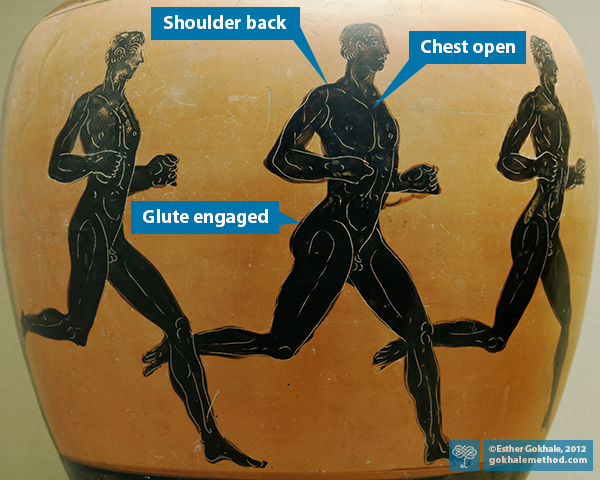
The Ancient Greeks inaugurated the Olympic Games ca. 776 BCE. Their figure drawings and sculptures—such as this vase dated to 333 BCE—depict bodies with healthy, highly functional posture.
The Gokhale Method® helps modern humans relearn these natural patterns. Our principles are taught through in-person Foundations courses, one-day Immersion courses, our online Elements course, and the Gokhale Active program.
Athletes across disciplines endorse this work. NFL MVP Roger Craig and world-record holder Patti Sue Plumer have both praised the method. Tennis legend Billie Jean King, winner of 20 Wimbledon titles, summed it up this way:
Esther’s technique for treating chronic back pain is totally unique and her research really backs it up. This is a great tool for all of us.
When someone of King’s caliber takes notice, it’s worth paying attention.
A four-point advantage
Gokhale Method courses deliver clear, practical benefits:
Injury prevention
Efficient alignment reduces the stress that leads to injury. Every movement—from reaching for coffee to getting in and out of the car—either reinforces healthy patterns or harmful ones.
Accelerated healing
When injuries occur, sound posture and movement support faster recovery by improving circulation and minimizing compensatory strain.
Enhanced performance
Healthy posture is an overlooked performance multiplier. Better stability, improved center of gravity, and optimal leverage through well-positioned joints translate directly into more power, speed, and endurance.
Longevity
Staying active isn’t just luck or genetics. With efficient biomechanics in place, you can keep doing what you love—for longer.
Train for healthy movement—from your living room, kitchen, and yard
As you enjoy the 2026 Winter Olympics, consider this: all athletes can use downtime to train smarter, not harder. Whether you’re training or not, the way you sit while watching the Games matters. The way you get up, walk, stand, prepare snacks, shovel snow, or drive your car matters.
Downtime Training® doesn’t require superhuman effort. It’s about returning to the natural, efficient movement patterns your body was designed for. From couch to conditioning, you can start now with a Gokhale® Consultation. If you’re a Gokhale alumnus and want help applying your posture knowledge more fully to daily life or sports, an Alumni Consultation can sharpen your results.
We’re here to help.
Best next step
Join one of our upcoming FREE Online Workshops using the sign-up below—and start training where it counts most.
Comments
I couldn't agree more with…
I couldn't agree more with this article. After being a gym rat for years and doing all kinds of exercise to fix my wildly askew skeletal system, from the second I heard "beanshape" and extrapolated what that meant to the rest of my skeletal system, the path was perfectly clear. Beanshape, contemplate, recalibrate, someday stand up straight. Given my structure, I made a 5-year-plan figuring it would take that long to rearrange my bones so that the muscles and tendons would fall into proper order to allow for proper body mechanics a la Gokhale.
I haven't gone near a gym to seriously pick up a weight since I stumbled upon the GM 11 years ago--I "pumped iron" in the 90's six days a week for three years. I was 30 pounds heavier then and had tons of strength, but lacked flexibility. In the early 2000's I swam laps for 45 minutes---again 3 years hardly missing a day-- great cardio but probably did more harm than good not using the Gokhale template.
If you simply bean shape and see in your mind what bean shaping means up the chain, you can see how out of line your skeletal system is from the Gokhale template and use a light counterweight (I used a couple of head cushions) to untangle your soft tissue before worrying about the specific muscles overly until better alignment is attained. All I need is a couple of head cushions used as counterbalance until I'm ready to think about building muscle mass. My goals are flexibility, balance and maintaining good reflexes. The GM keeps me ready for the Game of Life until I some day in the future I discover the illusive Rib Anchor.
I have always loved watching the Olympics and following the training of the athletes leading up to them on Wide World of Sports...."The thrill of victory ....the agony of defeat," since Rome in 1960. I would then use the Olympics as my baseline for the next four years. I still prefer when Summer and Winter Olympics were held during leap years only. I have many posture heroes from the Olympics. I try to follow the athletes actions when in slow motion replays. Great way to learn body mechanics.
I always try to kill two birds with one stone, so the Gokhale Method allows that--it's too logical (to the extent you choose to apply it to you life) not to work and you can do it anywhere anytime you choose. Thank you for making a molehill out of the looming posture mountain and allowing me be go through life more frictionless without ever having to leave my house house.
The long jumper can use her…
The long jumper can use her glutes as she 'glidewalks' because she has naturally strong glutes due to her genetics and her body proportions; she has a very short pelvis and long femur bones, so it comes naturally to her. I have a very long pelvis with very short femur bones, so attempting to keep my heels down & engage my glutes only stresses my hip flexors. I actually pulled my right hip flexor one year attempting to keep my heels down and engage my glutes as I walked.
The only way I can feel my glutes engaging is if I walk on my toes which I did as a child into my adult years, and because of this (and my genetics), I had very well developed glutes without needing to do any squats or other glute strengthening exercises. Many will attempt to do squats and 'glidewalk' to build glute muscles, but because they lack the genetics, they might be able to strengthen their glutes some what, but they will never have the coveted 'high-water booty' many long for.
Add New Comment
Login to add commment
Login