
2 Tips For Sitting Upright And Relaxed
For many students, learning that you can be both upright and relaxed is something of a revelation. Most of us associate good posture with stiffness, and relaxation with slouching. Yet the body is designed for a third option: upright ease. This Posture Awareness Month, I’m sharing two techniques to help you experience upright ease in your own body when sitting without a back rest.
Tip 1: Sit on your sitz bones
[Important: If you have a diagnosis—or any suspicion—of a herniated disc at L5-S1, do not attempt the following technique without help from a qualified Gokhale Method teacher.]
There’s a reason the bones at the base of your pelvis (or ischial tuberosities) are sometimes called the sitting bones or the sitz bones—they’re designed to be sat on! These two weight-distributing points of the pelvis provide a stable foundation upon which to ‘stack’ your spinal column.
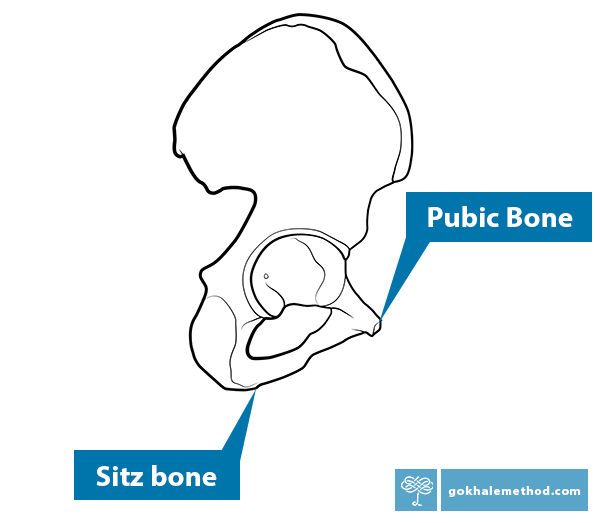
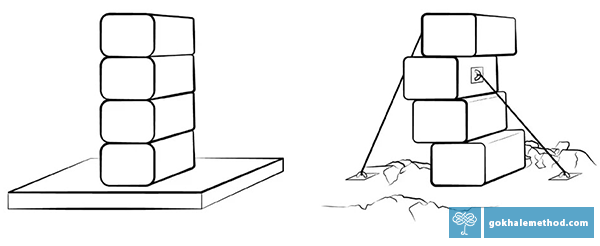
Sitting on your sitz bones provides a sound foundation for your “tower”. Tucking your pelvis compromises your “tower” with a poor foundation; it will need extra support from your muscles to remain upright.
When we align our bones optimally, the effort required to maintain upright posture is minimal. When the back muscles are relaxed, circulation to the tissues around the spine is unimpeded.
So, how to sit on your sitz bones in a way that allows the back muscles to relax?
The vast majority of people require some kind of prop to help tip their pelvis forward—some external object to add height to the back of the buttocks to antevert the pelvis. Imagine your pelvis as a bowl of water; you would like the water to spill gently out the front. Or imagine you have a tail—you’d like it to be out behind you, rather than curled under you.
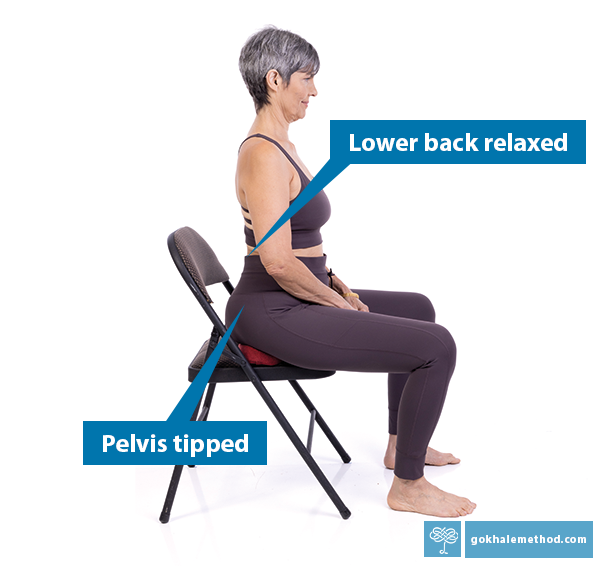
A prop under the back of the bottom helps to rest the pelvis in a tipped forward position, with your weight directly over your sitz bones and your ‘tail’ out behind.
I call this technique stacksitting. My book 8 Steps to a Pain-Free Back and my videos Back Pain: The Primal Posture™ Solution and Secrets to Pain-Free Sitting describe stacksitting in detail, with step-by-step instructions. It can be performed with the aid of a folded towel or fleece, or by balancing on the front edge of a seat. If you would like to try the Gokhale® Wedge, pictured above, which I designed specifically for stacksitting, we have opened our Buy-2-Get-1-Free sale early for readers of this blog.
Tip 2: Align your shoulders well
The aim in stacksitting is to stack your vertebrae in a more vertical arrangement. Habitually forward shoulders will round your upper spine. By performing shoulder rolls, the arms can hang along the back of the torso from shoulders that are in their natural posterior position, facilitating better stacking. You’ll also likely find that your shoulders can remain back without effort from the muscles between the shoulder blades. The result? Upright ease.
Watch this video to learn the Gokhale shoulder roll:
Shoulder rolls are a healthful technique in and of themselves that allows the blood vessels, nerves, muscles, and joints of the shoulders to be arranged optimally.
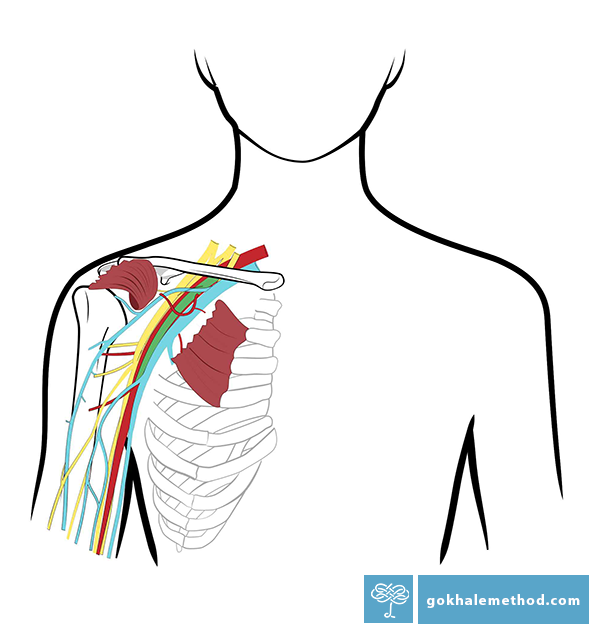
When the shoulders are open, the ‘superhighway’ of blood vessels (red, blue) and nerves (yellow) running under the pectoral muscles has plenty of space to function.
When you combine a well-positioned pelvis with naturally aligned shoulders, upright sitting no longer feels like work. As you experiment with these techniques, aim for a sense of balance rather than effort. Over time, this upright ease can become your new normal.
Best next step
Download my free ebook “3 Surprising Reasons You Have Back Pain (And How To Solve Them)”.
Comments
Add New Comment
Login to add commment
Login