
Embodied Empowerment
On International Women’s Day, March 8, there will be worldwide celebrations of achievement, courage, and resilience. This blog post contributes by exploring how healthy posture can support and express these qualities in a lasting, authentic way.
Many women have been shaped by subtle—and sometimes not-so-subtle—social messages about how to hold themselves. Research in communication and sociology finds that men are often encouraged to take up more physical and social space, while women are nudged to be smaller, more accommodating, and less imposing. From early childhood, girls may be praised for sitting “nicely,” minimizing their gestures—and often their comfort—while boys are encouraged to appear confident and expansive. These are, of course, current cultural patterns rather than eternal truths—and because they are socially learned, they can change.
Posture in the public eye
In recent decades, posture has entered mainstream conversation. Social psychologist Amy Cuddy’s 2012 TEDGlobal talk, Your Body Language May Shape Who You Are, was one of the most watched and debated TED Talks of all time. It helped popularize the idea that expansive poses project confidence and can confer social advantage.
This two-minute version of Amy Cuddy’s famous talk gives examples of “power poses”.
But some power poses can require excessive body tension and a somewhat “military posture,” with the chin lifted and chest thrust forward; these aren’t authentic, sustainable, or even healthy. It may look confident from afar, but inside it feels forced, and a “fake it till you make it” philosophy can carry us only so far. A truly empowered posture does not feel fake, nor does it make us feel as though we are gearing up for battle.
Short of doing the “power pose,” we have all been taught to “sit up straight” or “stand up straight.” This common “correction” is also misguided, as it simply replaces one problematic posture with another. True, we do not want to be relaxed and slumped, but we also don’t want to be upright and tense. Sometimes a swayback posture can signal eagerness, enthusiasm, or readiness to please—qualities often rewarded in dance or performance contexts. But when posture becomes a performance, it can feel overblown and contrived. Human beings are surprisingly perceptive; even when we cannot articulate it, we often sense when someone is presenting themselves in a compensatory rather than genuine way.
As far as your spine is concerned, swapping a hunched distortion for an arched distortion is still damaging, bringing sore muscles, compression, and wear and tear to discs, nerves, and bones.
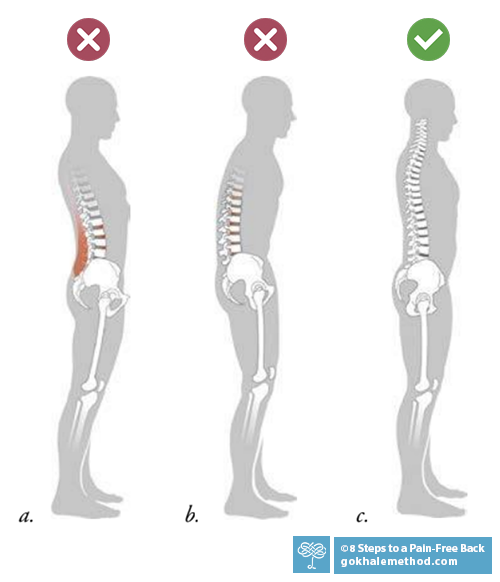
A retroverted pelvis leads to tense back muscles (a) or slumping (b). An anteverted pelvis and well-aligned rib cage facilitates healthy posture (c). (Drawings from my book, 8 Steps to a Pain-Free Back.)
Beyond rounded and collapsed or upright and tense
In the Gokhale Method®, we teach the healthy postural baseline found in pain-free populations around the world. This posture is free from damaging distortions and signals neither subordination nor domination. It is not collapsed and rounded—nor is it excessively swayed or arched in an effort to puff yourself up. It does not involve putting yourself down, downplaying your abilities, or making yourself small, nor does it constitute boasting, grandstanding, or self-aggrandizement.
Truly healthy posture is not a halfway compromise between two extremes—it represents an entirely different (in fact, time-tested) paradigm that is nuanced and essential to our well-being.
The techniques and principles that help remodel your posture are taught in logical sequence and detail in our in-person Foundations course, one-day Immersion course, our online Elements course, and our Gokhale Active program.
The real deal: sustainable empowerment through healthy posture
What the Gokhale Method teaches is profoundly uplifting for all moments of your day—and your life. It is not a surface-level trick. It is not a pretense. It is a way of aligning the body that is both powerful and peaceful—tempered by humility and steadiness. When posture becomes balanced and natural, you come home to your real self.
Musician and activist Joan Baez has described the Gokhale Method as “the real deal,” reflecting the depth of experience many students feel. True empowerment is rarely loud or theatrical; rather, it is authentic, textured, and quietly strong.
The new posture that becomes your new normal
Sometimes people feel they can’t spare the bandwidth to learn to use their body well and instead want a pill or surgery to take the problem away. But with the Gokhale Method, the commitment and effort required are surprisingly small, and the rewards surprisingly large. One student put it this way: “Small tweaks, big results.” Physically, the posture we teach requires much less energy than the “sit up straight” posture. Mentally, as healthy alignment becomes deeply embodied, it simply becomes your new normal.
My photo of the African carpenter who insisted that I take his photo (I don’t usually take posed photos) tells the story well: his clothes are tattered; his ski cap looks comically out of place; but his posture and presence show the natural dignity, beauty, and self-possession that belong to all of us.
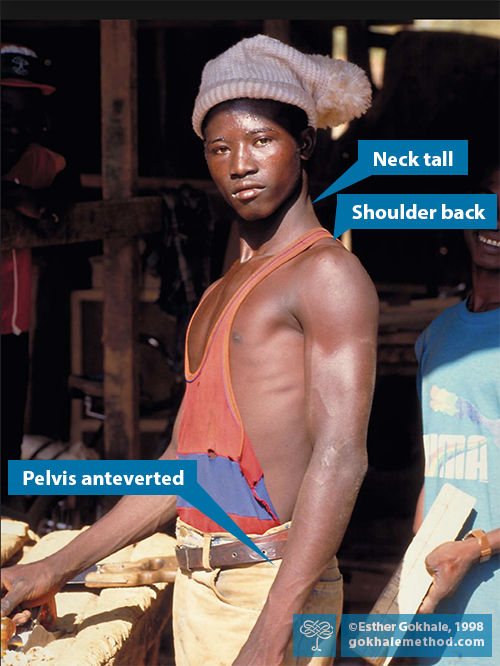
Posture empowerment transcends gender, culture, and circumstance—as this African carpenter shows.
Join our special free online workshops to celebrate International Women's Day 2026
On this International Women’s Day, consider what empowerment might look and feel like in your body: a posture that neither shrinks nor dominates, and that helps you show up fully, authentically, and joyfully in your life…
Alumni, join us for a special workshop, Posture, Presence, and Personal Power, on Saturday, March 14. All alumni on our newsletter list will be invited by email. (Reach out to [email protected] if you are a Gokhale Graduate who does not receive an invite and would like to attend.)
For newcomers, we have a special workshop, Embodied Empowerment, on Sunday, March 15, at 11:00 a.m.–12:00 p.m. (PST).
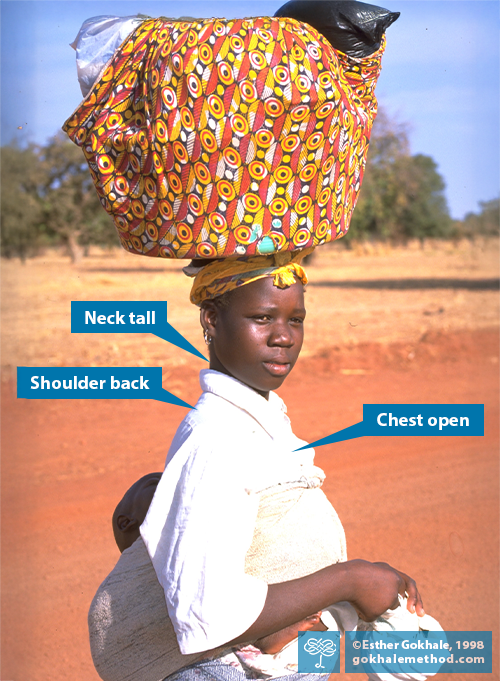
The healthy postural alignment of this Burkinabé woman lends poise and efficiency to her daily tasks.
Best Next Step
Join one of our upcoming FREE Online Workshops using the sign-up below—and find your own empowerment.
Comments
Add New Comment
Login to add commment
Login